Reports indicate that a bread purchase management system has been implemented in Arabistan (formerly officially designated as Khuzestan) and Zanjan province over the past two days, as part of a structured and planned measure, without clear prior notice to residents or bakeries.
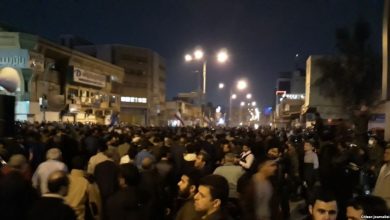
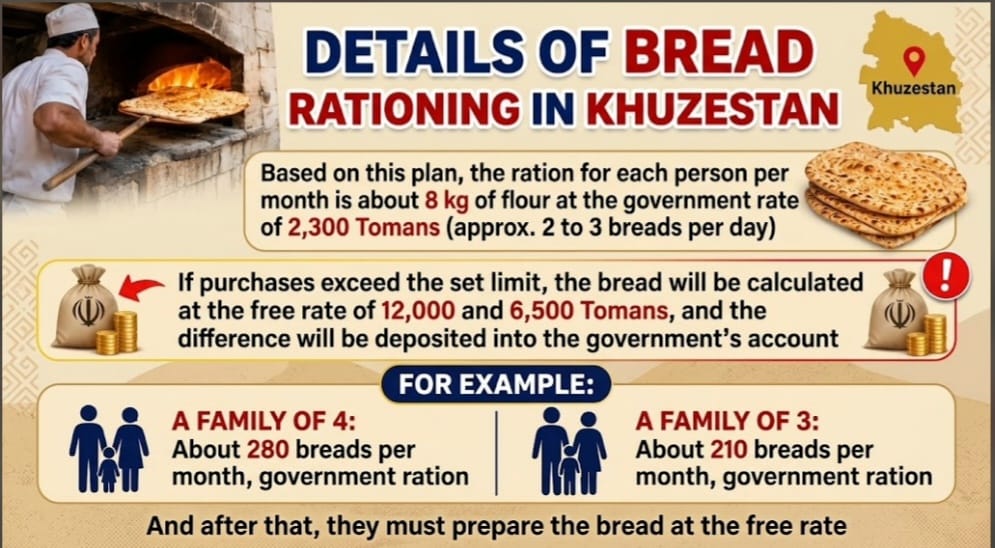
According to the reports, the system was activated in Arabistan and Zanjan without informing consumers or bakeries in advance, leading to queues, disputes, and confrontations outside some bakeries. The reports stated that the monthly allocation per person is approximately 8 kilograms of subsidised flour, priced at around 23,000 rials per kilogram, while purchases exceeding the allocation, or classified as unusual, are charged at a significantly higher commercial rate.
In contrast, officials stated that the system concerns the management of unusual purchases, and that daily household purchases are not subject to price restrictions. However, this clarification has not prevented concern among residents, particularly in the absence of written and publicly available guidelines clarifying the scope of implementation and the method for calculating allocations.
The available facts indicate that the system was not a random or temporary measure, but a structured step involving the setting of quotas, a mechanism for calculating additional purchases, and the application of different prices depending on the type of purchase.
The initiation of implementation in Arabistan and Zanjan, without prior announcement or clear clarification, raises serious questions about the criteria for selecting areas and the fairness of implementation. The lack of transparency, in a region already suffering from chronic economic and social marginalisation, increases concern about the impact of the policy on the Ahwazi population.
A.O.H.R. cannot, in the absence of official documents or verified data, confirm the existence of discriminatory intent. However, the lack of transparency, and the initiation of implementation in Arabistan before other areas, obliges the authorities to provide a clear and convincing public explanation, and to ensure that the Ahwazi people do not bear a disproportionate burden.
Observers note that setting a monthly quota, combined with a commercial price for additional purchases, may limit the ability of large and low-income families to secure sufficient food.
Bread, in many poor families, is not an ordinary consumer good, but a staple food and a cheaper substitute for meat, proteins, and fruits. Therefore, any restriction on access to subsidised bread may push families to reduce the quantity or variety of food, increasing the risks of food poverty and malnutrition, particularly among children, pregnant women, and the elderly.
The impact is more severe for families relying on a low salary or lacking a stable source of income, as they may not have the financial capacity to purchase additional quantities at the commercial price.
Risks of Malnutrition Among Children
A.O.H.R. warns that any decline in the quantity or variety of food may increase the risks of malnutrition among children, particularly in early childhood, when nutritional needs are higher and the impact of deficiency is more severe.
A.O.H.R. clarifies that malnutrition does not only mean a lack of food, but also includes deficiencies in essential vitamins and minerals necessary for growth and development. This includes deficiencies in iron, iodine, zinc, and other vitamins, which play a fundamental role in building the body, brain, and immune system.
The potential health risks of malnutrition among children include:
1- Stunting: low height-for-age, resulting from chronic or recurrent undernutrition, limiting a child’s ability to reach their full physical and cognitive potential.
2- Wasting: acute weight loss relative to height, usually associated with severe food shortage or recurrent illness, increasing the risk of death if not properly treated.
3- Weakened immunity:malnutrition weakens the immune system, making children more susceptible to infectious diseases such as diarrhoea, pneumonia, and measles, and increasing the severity and duration of these illnesses.
4-Delayed cognitive and mental development: nutritional deficiency in early years may negatively affect brain development, cognitive abilities, and school performance, with potentially long-term effects.
5- Anaemia and micronutrient deficiencies: deficiencies in iron and other vitamins and minerals may lead to anaemia, poor concentration, fatigue, and impaired growth.
6- Long-term effects on health, education, and income: children suffering from malnutrition may face learning difficulties and lower school performance, which may later be associated with reduced economic opportunities in adulthood.
A.O.H.R. emphasises that these risks increase in the context of poverty, reduced purchasing power, and rising food prices, where families may be forced to rely on less varied and lower-quality food.
Economic Context
This measure comes at a time of rising food prices and declining purchasing power. The World Bank estimated that food inflation in Iran reached approximately 99% year-on-year in February 2026, while warning that rising prices and declining real incomes increase the risks of poverty and food insecurity.
In August 2026, the authorities announced the inclusion of more than 262,000 children aged 5–59 months in a free food assistance programme after classifying them as malnourished. These figures are not used as evidence of documented malnutrition in Arabistan specifically, but they confirm that poor nutrition represents a national risk requiring additional protection for the most vulnerable groups.
A.O.H.R. relies on Iran’s international obligations, particularly:
1- Article 11 of the International Covenant on Economic, Social and Cultural Rights: the right to an adequate standard of living, including adequate food.
2- Article 12 of the same Covenant: the right to the highest attainable standard of physical and mental health.
3- Article 24 of the Convention on the Rights of the Child: the child’s right to nutrition and health care.
4- Article 27 of the Convention on the Rights of the Child: the child’s right to a standard of living adequate for physical, mental, spiritual, moral, and social development.
5- The principle of non-discrimination: the obligation to ensure that no population or regional group bears a disproportionate burden without a clear and objective justification.
Regulating the distribution of subsidised goods or preventing commercial exploitation does not conflict with these obligations, provided it is transparent, legal, non-discriminatory, proportionate to its purpose, and subject to oversight and appeal.
A.O.H.R. demands that the Iranian authorities *immediately withdraw the bread purchase restrictions from Arabistan, and cancel the measure at the national level*, due to the potentially serious humanitarian impact on poor and large families, and the risks of malnutrition among children.