Ahwazi Human Rights Organization: What is happening in Ahwaz is no longer mere environmental degradation. It is the deliberate destruction of the foundations of life, and the figures acknowledged by Iranian officials themselves confirm this.
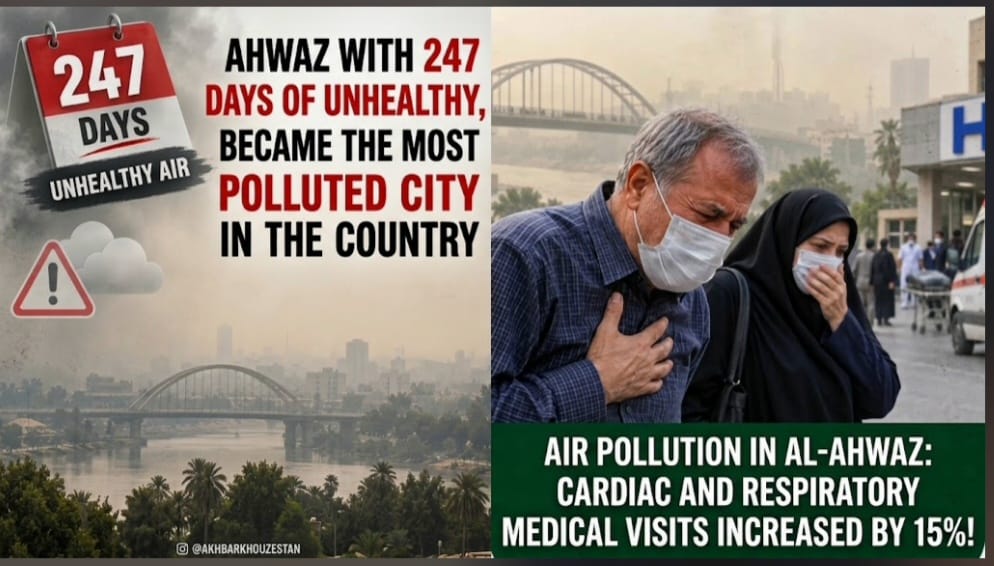
The head of the National Center for Air and Climate Change at Iran’s Department of Environment announced that the city of Ahwaz recorded 247 days of unhealthy air between March 2021 and March 2025. Local media described it as the most polluted city in Iran. At the same time, an official at Jundishapur University of Medical Sciences reported a 15% rise in visits for heart and respiratory conditions, and said that 9,920 patients visited medical centers within 24 hours as of the morning of 17 November 2026. The official warned that this increase is an alarm bell for public health.
The Organization stresses that these official figures do not reflect the true scale of the crisis, and that the reality is worse than what has been announced.
Drawing on its own studies and on human rights and Ahwazi reports, the Organization documents a series of practices behind this deterioration:
1. The theft of approximately 14 billion cubic meters of Ahwaz’s water every year, diverted outside the region to Iran’s central provinces to revive tourism and agriculture.
2. The construction of approximately 118 dams, built and planned, of which more than 76 are already built, according to the Organization’s study, which consists of three reports.
3. The prevention of farmers from cultivating their land, resulting in the expansion of desertification and the destruction of soil fertility.
4. The transformation of what remains of the rivers’ water into stagnant, highly saline water.
5. A rise in cases of cancer, asthma and shortness of breath, with Ahwaz ranking first in Iran in the number of people affected by these diseases.
6. The destruction of more than 30 million palm trees and the forced displacement of the residents of dozens of villages.
The Organization considers that the continuation of these practices, with the authorities’ knowledge of their consequences, amounts to ecocide. It also constitutes slow violence that gradually pushes the population toward illness, displacement or death, and forced environmental displacement that targets the Ahwazi presence on its land. The Organization regards this as a violation of the rights to life, health, water, food, a healthy environment and livelihoods.
The Organization calls on the competent international bodies to examine whether these practices fall under Article II(c) of the Convention on the Prevention and Punishment of the Crime of Genocide, which prohibits deliberately inflicting on a group conditions of life calculated to bring about its physical destruction in whole or in part.
The Organization demands:
1. The opening of an independent international investigation into the environmental and health conditions in Ahwaz.
2. An end to water-theft projects, including the construction of new dams and the operation of existing ones in ways that hold back the waters of Ahwazi rivers, and the restoration of Ahwaz’s water shares.
3. Permission for farmers to cultivate their land, and a guarantee of their right to water and land.
4. The publication of transparent data on pollution, salinity and disease levels.
5. The provision of healthcare and compensation for those affected, and the return of displaced residents to their villages.
6. Urgent action by the United Nations Special Rapporteurs responsible for the environment, water, health and human rights.
7. Accountability for the Iranian authorities for these violations.